Growing Up With a Narcissistic Mother
“But she’s your mother.”
You’ve heard some version of this your whole life. Mothers are supposed to love unconditionally. Adult children are supposed to forgive, stay loyal, keep showing up. And so when the relationship with your mother has repeatedly required you to abandon parts of yourself just to stay close to her, there’s nowhere obvious to put that. The culture hasn’t given you language for it. It’s only given you a rule, and the rule doesn’t fit what you lived through.
I want to be upfront about something before we go further. This article isn’t about diagnosing your mother or deciding whether she has a personality disorder. What I am interested in is something more useful to you: persistent patterns, for example, control, entitlement, repeated difficulty taking accountability, difficulty tolerating your separateness from her, manipulation or approval that is often tied to you playing a particular role. You don’t need a diagnostic label to take seriously what happened between you and your mother. You just need to notice the pattern, and what it cost you.
When Love Feels Conditional
This is where it usually starts.
Somewhere in early childhood, without ever being taught it directly, you learn an equation: When I please Mum, I get closeness, warmth and praise. When I differ from Mum, when I show my own taste or opinion, even in a small way, I get criticism, withdrawal, guilt or anger. It doesn't take many repetitions of this pattern before a child stops experimenting quite so freely with who they might be and starts shaping themselves around who their mother needs them to be.
This isn't a conscious decision. No one sits down and decides to abandon themself. You simply do what children do brilliantly: read the environment and adapt to what keeps you safe and connected. As you grow, the clothes you wear, the interests you pursue, the university you apply to, the friends you keep, even the opinions you express can all become shaped around a single, unspoken question: will this keep the peace?
And in a relationship shaped by narcissistic patterns, keeping the peace can come to mean staying within the role your mother is most comfortable with you occupying: reflecting well on her, agreeing with her, continuing to need her and not becoming so separate that your independence feels threatening.
When You Become an Extension of Your Mother
Underneath all of this sits something harder to name: a mother who has real difficulty experiencing her daughter as a separate person.
I don't mean this in a literal, possessive sense, as in you belong to me. It's subtler than that, and in some ways more corrosive. It sounds more like: your choices reflect on me. Your disagreement is a rejection of me. Your independence is disloyalty. A daughter who develops different tastes, different political beliefs or a different way of parenting is not simply experienced as different. Her separateness can be felt as a threat, an insult, evidence that something has gone wrong.
This is why ordinary developmental moments- a different style at fourteen, a university course her mother wouldn't have chosen, a boyfriend she doesn't approve of- so rarely stay ordinary. They can become loaded with meaning and reinterpreted as rejection or betrayal. And a daughter who has learned how large the reaction might be may begin to minimise herself before it even happens; she might share less, ask for less, keep her opinions to herself, or choose what feels least likely to provoke conflict.
When You Never Know Which Version of Mum You'll Get
One of the more disorienting features of this dynamic is its unpredictability. One day: you're beautiful. Another day: you've put on weight. One day: you're so talented. Another: you're useless, just like your father.
There's no consistent logic connecting these, which is precisely what makes it so destabilising. A child who grows up under unpredictable feedback like this develops a particular kind of vigilance. Instead of learning to ask what do I think, what do I feel, what do I want, the questions that eventually build a stable sense of self, she becomes extremely skilled at asking a different question, almost constantly: what does Mum think of me right now?
That habit of externalised self-worth doesn't stay behind in childhood. It comes with her into adulthood, often long after she's physically left the house.
What May Have Been Missing in Childhood
It's worth naming something that often gets left out of these conversations: alongside the emotional volatility, there is frequently neglect.
Emotional neglect looks like not being comforted when you were upset. Not being listened to, not being protected, not being allowed to have feelings that were inconvenient for your mother.
Practical neglect looks like being left alone too young. Learning to prepare your own food, manage your own hygiene, do the shopping, handle school responsibilities on your own, sometimes even taking care of siblings or the household itself. This is often what's meant by parentification: a child stepping into responsibilities that were never theirs, because no one else was going to.
You May Not Have Known It Was Neglect
Here's the thing about growing up this way: you rarely experience it, in the moment, as neglect. Children don't have the framework to think I'm experiencing emotional neglect or this is parentification. What you think, instead, is something closer to: I'm independent. Mum has a lot going on. I'm mature for my age. Other kids have it so much worse than me.
You weren't wrong to think that. You were doing what children do, making sense of your circumstances with whatever explanation kept things bearable. And often, those explanations got reinforced from the outside too. You were the capable one. The mature one. The one teachers and relatives could rely on. It felt, at the time, like a strength.
What can be disorienting in adulthood is realising that some of what you were praised for- the self-sufficiency, the emotional composure, the ability to manage things far beyond your years didn't start as strength at all. It started as adaptation. A child figuring out how to get her own needs met because there wasn't reliably anyone else doing it. That doesn't make the strength less real now. But it's worth knowing where it came from.
“But Everyone Thought She Was a Wonderful Mother”
Narcissistic mothers are frequently very good in public. Charming and generous, the kind of mother other people describe admiringly at school pickup. And so one of the reasons adult daughters can struggle to trust their own memories is that the family everyone else saw may have looked nothing like the family they actually lived inside. If the version of your mother that the world knew doesn't match the version you knew, that gap isn't evidence that you misremembered. The fact that other people experienced a very different version of your mother doesn't invalidate the version you experienced at home.
“Did She Know What She Was Doing?”
This is one of the questions I hear most often, and honestly, sometimes yes, sometimes not entirely, and sometimes you will never know for certain.
I'd suggest that's not actually the most useful question to spend your energy on. A more useful one is this: what happens when the hurt is named? When you tell her, clearly, that something she did affected you, does she get curious? Can she tolerate hearing it without immediately explaining why it was actually your fault? Can she apologise without turning the apology into something you now have to manage her feelings about? Does anything change, even slightly, afterwards?
That question moves you away from an exhausting and ultimately unanswerable search for intent and toward something you can actually observe: impact, pattern, and how she responds when the impact is named. That's the information that matters.
“Does She Even Love Me?”
I want to keep this question in the conversation, because I suspect it's the question many of you are asking. But I want to separate two different things: love as an internal feeling she may genuinely experience, and love as something you experienced relationally, in your body, over years.
Your mother may tell you she loves you. She may, in her own frame of reference, believe it completely. The more important question isn't whether that's true for her. It's: What has love felt like to you? Did it require obedience? Agreement? Constant availability? Achievement? Putting her needs ahead of your own? Not embarrassing her? Not leaving?
You don't have to resolve the philosophical question of whether your mother ever loved you. You only have to be able to say, honestly: I experienced her love as conditional. That sentence is enough to build on.
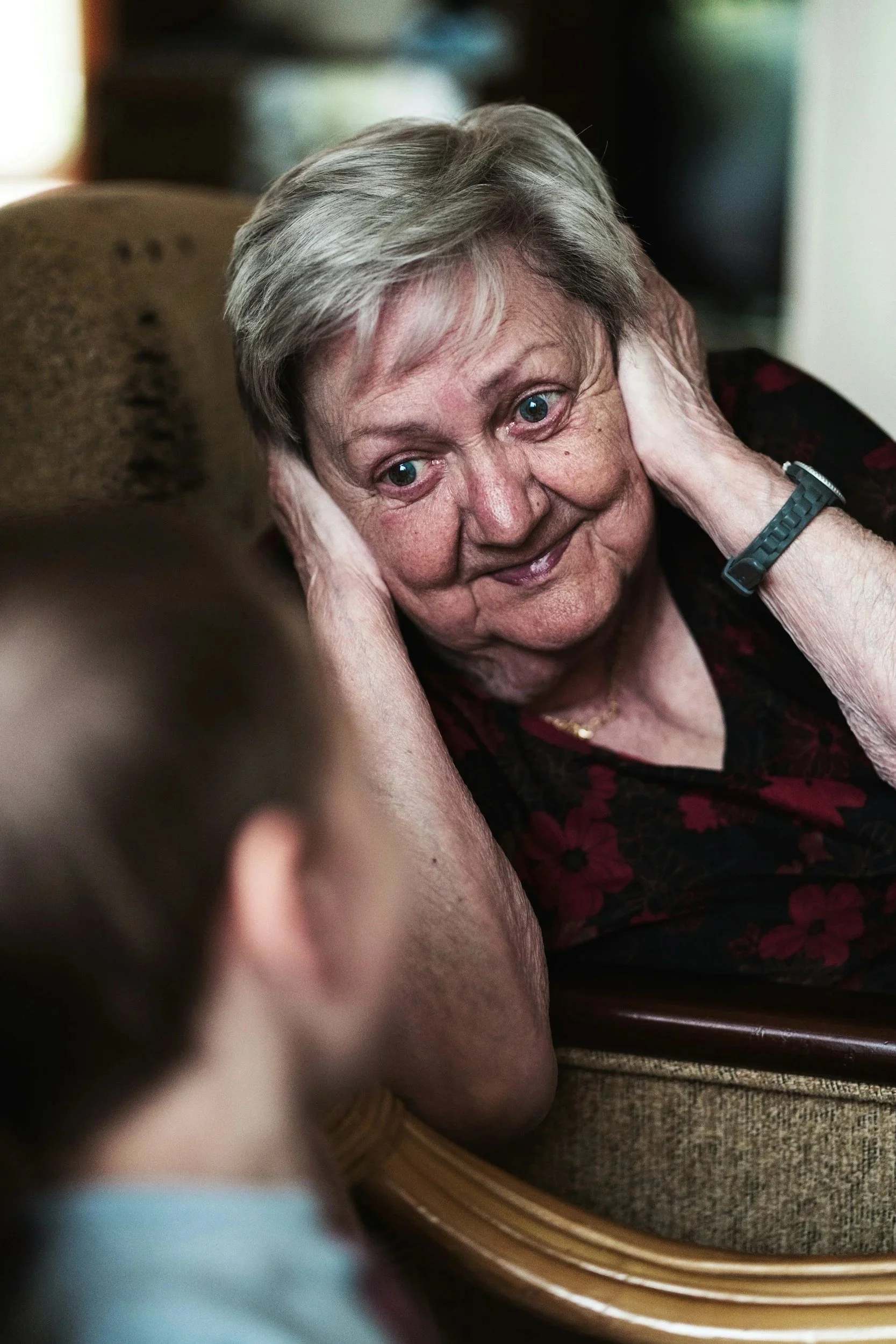
When there seems to be little room for your voice.
Why Becoming an Adult Can Make the Relationship Worse
Once this pattern is in place, adulthood tends to make things harder rather than easier, because adulthood is, by definition, a series of steps toward separateness. Moving out. Building a career. Choosing a partner. Marriage. Having children. Parenting differently to how you were parented. Spending a holiday with someone else's family. These aren't simply milestones. They make your separateness from her impossible to ignore.
Partners Can Become the Problem
If your mother experiences your autonomy as rejection, the person who supports your autonomy can easily become the person she blames for it. Suddenly your partner is the one who “changed you”, who's “turned you against” your family, who's excluded, undermined, criticised at every opportunity. It rarely has much to do with your partner as a person. It has far more to do with the fact that your partner represents a life that no longer needs to be managed by her.
When You Become a Mother Yourself
This one deserves particular attention, and it's a topic I've written about more fully in relation to parenting and family dynamics, because it opens up so much.
Grandchildren create an entirely new arena, around access, around authority, around whose rules apply in whose house. And becoming a parent has a strange way of forcing women to re-examine their own childhoods from a completely new angle. You look at your own child, at how fiercely protective you feel of her, and something in you realises: I could never do to her what was done to me.
That realisation can bring enormous grief. Not just for what you're protecting your own child from, but for the fact that you weren't protected in the same way.
Why Do I Feel So Guilty?
By now, many of you have done real work. You know, intellectually, that you're allowed to say no. You know you're not responsible for your mother's feelings. And still, you set one small boundary, and you feel terrible. Not mildly uncomfortable, but terrible. And the question that follows is almost always the same: if I know all this, why do I still feel so guilty?
Because knowing a boundary is reasonable and having a nervous system that has learned, over years, to expect consequences for autonomy, those are two entirely different things. One lives in your thinking mind. The other lives in your body, in patterns laid down long before you had the language to question them.
What you might be feeling is conditioned guilt, conditioned shame, a fear response, and often a well-practised habit of fawning, of appeasing before conflict even fully arrives, because appeasing is what kept you safe for so long. And here's the distinction I want you to remember: feeling guilty doesn't necessarily mean you've done something wrong. Guilt and shame aren't the same experience, and they don't carry the same information; that's a whole conversation in itself. But for now, it's enough to know that sometimes guilt is simply what autonomy feels like in a body that once learned compliance was the price of connection.
The Other Parent: “Can't You Just Make Peace?”
If there was a second parent in the picture, this is often where they show up.
The quieter parent can look, for years, like the safe one, the one who never yelled, never criticised, never made you feel small. But if their strategy for surviving your mother was appeasement, then your boundaries create a genuine problem for them too. Because while you're setting boundaries from a distance, they're often still living with the fallout at close range.
This is where you start to hear things like “she's your mother”, “you know what she's like”, “just call her”, “do it for me”. And suddenly you're not simply managing your relationship with your mother; you're being asked, again, to regulate the whole family system. That's triangulation, and it's exhausting precisely because it recruits your love for one parent against your protection of yourself.
Grieving the Mother You Needed
There is a grief specific to this experience, and it deserves far more space than it usually gets.
You can grieve the childhood you didn't have. The protection you needed and didn't receive. The mother you kept hoping she'd eventually become, if you just explained yourself clearly enough, tried hard enough, waited long enough. The apology you may never receive. The fantasy, and it is a fantasy, even though it doesn't feel like one from inside it, that if you could just find the right words, she would finally understand.
Importantly, this grief doesn't require estrangement to be real, and it doesn't require estrangement to begin healing. You can remain in contact with your mother while still relinquishing the hope that the relationship will become something it has repeatedly, consistently shown you it cannot be. Those two things, staying and letting go of the hope, are not contradictions. They can coexist.
Boundaries Without Going Straight to No Contact
I want to be clear that no-contact isn't the implied finish line of this work, even though it can sometimes feel like the only "real" option once you understand what's been happening.
In practice, contact tends to sit on a continuum: full contact, more structured contact, limited information shared, reduced contact, a temporary break, no contact. People move along this continuum in both directions, sometimes more than once, depending on what's happening in their life and hers. None of these positions is more “correct” than the others. What matters is which one allows you to stay intact.
What a Boundary Actually Is
It's worth being precise here, because I think this gets misunderstood often. A boundary isn't “you need to stop criticising me.”That requires her cooperation, and you don't have any control over whether she gives it. A boundary looks more like: “If this conversation becomes insulting, I'm going to end the call.” That one doesn't need her agreement at all. It only needs you.
Communication
Some practical shape this can take: text can be easier to manage than phone calls, because it gives you space to respond rather than react. Shorter responses tend to hold up better than long, justified ones. You don't need to answer immediately, and you don't need to engage with every accusation that comes your way. None of this needs to be rigid or perfectly executed every time. It's simply a direction to lean in.
Physical Boundaries
The same principle applies to things like unannounced visits. You're allowed to decide who has access to your home and when, and that decision doesn't require her approval to be valid.
Birthdays, Christmas and Major Events
Some people notice that significant occasions repeatedly become overshadowed by conflict, crises or demands for attention. The point isn't to assume every crisis is manufactured, but to notice recurring relational patterns and decide in advance how you want to respond.
Do I Need to Cut Contact With My Mother?
I get asked this often, and I want to be honest: no blog post can answer that for you, and you don't need to make a permanent decision about it today.
What tends to be far more useful than the question “Is she a narcissist, so should I go no contact?” is a slower set of questions you can consider. How do you generally feel before, during and after contact with her? Can boundaries exist in this relationship without retaliation? Does she respect your parenting, your partner, your choices? What actually happens when you say no? And, most importantly: What level of contact allows you to remain psychologically intact? That last question is really the one underneath all the others.
What About Family Therapy?
Joint sessions can sound appealing. Surely, if a professional is in the room, things will finally be heard fairly. In practice, I'd encourage caution here. Where there's a history of coercion, intimidation, emotional abuse, or retaliation, or where you're not able to speak honestly in front of her without fear of consequences afterwards, joint work simply isn't safe yet. Family therapy requires a baseline of relational safety that these dynamics often don't have. Individual work first tends to be the more protective, and often more productive, starting point.
Becoming Your Own Person
The goal was never getting your mother to admit what happened or getting the rest of the family to finally believe you. It was never winning an argument about whether she meets criteria for anything. And it isn't becoming someone who is completely unaffected by her, either. It isn't the point.
The goal is developing an internal reference point of your own. Moving from “What will Mum think" toward “What do I think." and from“Is she upset with me?” toward “Am I okay with the choice I've made."“From “How do I make her understand” toward “Do I understand myself.”
So when someone well-meaning says “But she's your mother," you answer “And I'm her daughter.”
Closing
Separating psychologically from a parent doesn't mean you never loved her. It doesn't make you cruel and it doesn't necessarily mean you have to leave the relationship altogether. Sometimes it simply means beginning to understand something more foundational than any of that: being someone's daughter does not require abandoning yourself.
If this piece has resonated and you'd like support working through your relationship with a parent, I'd be glad to help.
📧 kat@safespacecounsellingservices.com.au
📞 0452 285 526
A Few Common Questions
How do I know if my mother is actually narcissistic?
Honestly, you may never know for certain and you don't actually need to. A proper diagnosis can only come from a qualified professional who has actually assessed her, not from a checklist, a blog post, or a conversation with me. What you can know, without anyone's assessment, is your own experience: the pattern of what happened, how it affected you, and how she responds when that impact is named.
Understanding the relationship doesn't depend on obtaining a label for her.
Can a narcissistic mother change?
Sometimes, to a degree, but it depends on things that are genuinely rare to find: real insight into how her behaviour affects others, a willingness to take accountability without immediately deflecting it and sustained behavioural change over time, not just a good week or a heartfelt conversation after a blow-up. A single apology, or a period of noticeably better behaviour, isn't the same as change. What matters is whether it holds up consistently, especially when nobody's watching and nothing is at stake for her.
Why do I feel worse after talking to my mother?
This is common, and it's worth paying attention to rather than dismissing.
Many people notice a pattern if they check in with themselves before, during, and after contact: there might be a kind of bracing beforehand, an activation or fog during the conversation itself and afterwards a wave of rumination, guilt or self-doubt that can last for days.
That's not you being oversensitive; it's often a fairly reliable signal about what this particular relationship costs you and it's useful information when you're deciding what level of contact you can sustain.
Can I have a relationship with my mother and still have boundaries?
Yes. This isn't an either/or. Plenty of people stay in contact with a mother like this while being far more selective about what they share, how much access she has, and what they will and won't tolerate in a conversation.
Boundaries aren't a stepping stone toward inevitable estrangement. For many people, they're what makes an ongoing relationship survivable at all.
Related Reading
If this piece resonated with you, you might also find these helpful:
Emotionally Immature Parents: Their Impact and Breaking the Cycle
The Difference Between Guilt, Shame and Toxic Shame (coming soon)
When Caring Becomes Self-Abandonment (Understanding Codependency)